
Resale programs: curating desire, proving quality, strengthening relationships


Your brand already exists in the secondary market. Whether you decide it or not, your pieces circulate, get compared, gain value, get exchanged. The question isn't whether to launch a program, but what role to give it: a simple resale flow, or a truly integrated experience.
When treated as a mechanism, resale remains peripheral. When embedded in the brand's DNA, it becomes an asset that fuels desirability, builds trust, elevates experience, and deepens customer relationships.
In this article, we show how a brand can turn resale into a desirability asset:
1. An untapped territory of expression
An asset serving brand equity, not just another channel
Resale is often introduced as a transactional matter, with its metrics and operational constraints. In reality, it opens a territory few brands fully exploit: the ability to tell your brand story over time, through pieces already desired.
A brand-owned resale program can become a natural extension of the universe, because it puts the piece at the center, its cut, its history, its style. It's not about adding an offering. It's about creating the stage for the long game, where the brand expresses what it truly is.
Resale then becomes a brand equity asset: it influences value perception, structures access to the brand without degrading its codes, and reinforces experience consistency, even when the piece has already lived.
2. Emotion: resale embedded in brand DNA
Taking back control of circulation, restaging the pieces
A brand isn't defined solely by what it produces, but by how it stages its pieces, silhouettes, signatures. Resale, when left out of the equation, loses this staging. Pieces circulate, but without brand language, without consistency or intention.
Embedding resale in the brand's DNA means doing the opposite. It means reinvesting in circulation and giving pieces their rightful place. It allows the brand to say: these pieces are part of our universe, they transcend time, they deserve to be seen and passed on with care.
Emotion emerges there: the brand embraces the continuity of its value.
3. Desirability: curation as the engine
Curation, drops, editorial line, resale becomes a selection, a space for expression, an appointment
Desirability isn't built through accumulation. It's built through curation. Strong resale isn't an inventory: it's a curated collection, rhythmic and narrated.
Curation. Highlighting signatures, iconic pieces, variations that express the brand's taste. You no longer "manage" stock: you compose a selection, with hierarchy, aesthetic, intention.
Rhythm. Drops, appointments, moments. The calendar creates anticipation, establishes habits, fuels conversation.
Editorial line. Connecting pieces to a style, a use, a silhouette, an era. A piece isn't just a price and condition: it belongs to a universe, and that universe creates desire.
This triptych, selection, rhythm, narration, transforms resale into a space for expression.
4. Trust: buy-back makes quality tangible
Buy-back, inspection, recirculation, durability becomes fact, value becomes a signal
Saying pieces are durable is an intention. Buy-back, when owned by the brand, transforms that intention into proof.
Buy-back makes quality tangible because it commits the brand beyond the first life. It requires inspection, validation, recirculation under standards. It makes condition readable, quality verifiable, experience reassuring.
For the customer, the signal is clear. The brand doesn't just claim, it commits. It buys back, inspects, certifies, recirculates. Durability stops being discourse to become fact. And residual value becomes a trust signal that naturally elevates the new.
5. Experience: a "new-level" standard for purchase and buy-back
Clarity, visuals, service, seamless journey, buy confidently, trade in simply, return naturally
Resale plays out in two experiences: purchase and buy-back. And both must be at the level of new.
On purchase, everything hinges on precision. Clear condition, polished visuals, useful information, a product page that reassures as much as it inspires, fluid service. Resale naturally introduces uncertainty. The brand's role is to absorb it through standards.
On buy-back, everything hinges on simplicity and clarity. A seamless journey, understandable assessment, clear trade-in value, instant credit, service that invites repetition.
The benefit for customers is direct: buy confidently, trade in simply, return naturally. Experience becomes a loop, and this loop makes the program alive.
6. Relationship: buy-back as a moment of recognition
Clienteling, status, attention, credit becomes a brand gesture, attachment builds through repetition
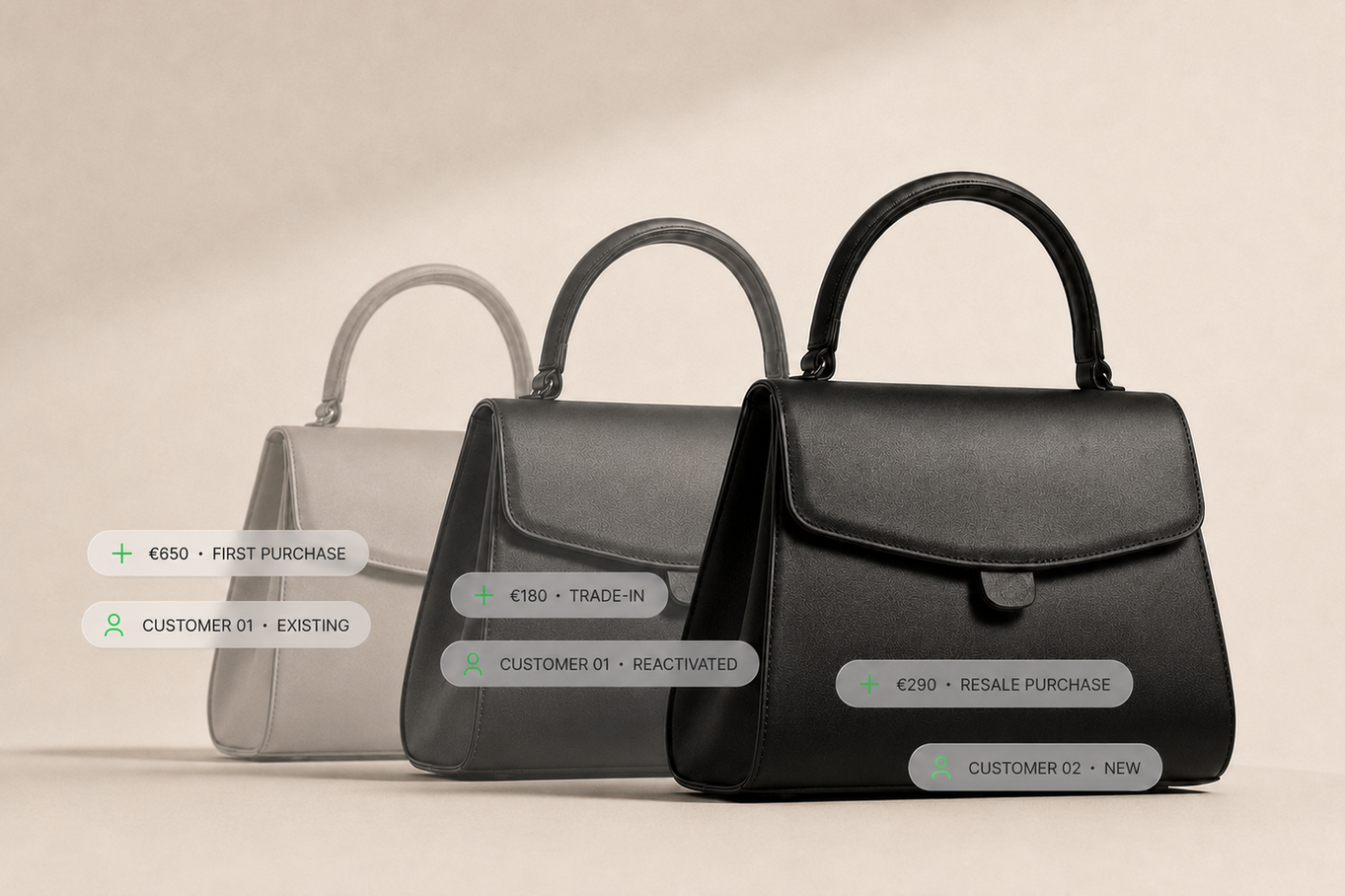
Buy-back is a rare moment: a customer returns with a pre-owned piece. It's when the brand can do what it does best, welcome, advise, acknowledge.
Well-designed, buy-back becomes a clienteling moment. It extends style, guides choices, recommends pieces, offers early access to curated selections, establishes status. It brings attention, continuity, consideration.
In this context, credit takes on a different meaning. It's not a mechanism. It becomes a brand gesture, a way to thank and invite back. And attachment builds through the repetition of these moments, because they're consistent, demanding, and deeply human.
The New Reality
Resale already exists. The question is what story it tells.
When treated as mere logistics, it remains peripheral. Embedded in the brand's DNA, it becomes a desirability asset over time, because it curates desire, makes quality tangible, elevates experience, and deepens relationships.
It's this shift from operational program to brand chapter that transforms resale into a strategic imperative.
.png)




Stay ahead of the game!
Sign up to FAUME's The Secondhand Review newsletter
Read inspiring stories from brands that have successfully launched their secondhand businesses with FAUME