
In 2026, "Watching" the secondhand market is no longer enough


"We're watching the secondary market."
That phrase comes up often in board meetings. It signals awareness, a willingness to treat resale as something worth monitoring rather than ignoring. For a long time, that was already progress.
But that posture has its limits. It implies that resale remains adjacent to the core business, a market observed from a distance.
The secondhand market is no longer a parallel phenomenon. It already influences what your customers are willing to pay, what they consider credible value, and how they discover your brand, sometimes before any direct contact with you.
The Scale Shift Has Already Happened
Figures vary depending on methodology. Perimeters differ. But the general direction is clear.
ThredUp / GlobalData: The global secondhand apparel market grew 15% in 2024 and now represents 9% of total worldwide apparel spending.
BCG / Vestiaire Collective: The secondhand fashion and luxury segment is worth between $210 and $220 billion today. It could reach $360 billion by 2030, growing at nearly 10% annually, three times the rate of the new goods market.
At that scale, this market no longer simply reflects value. It is beginning to shape it.
Pricing Is Now Being Decided Outside Your Perimeter
Your pricing decisions rest on solid foundations: cost structures, range architecture, market positioning, promotional discipline. That framework remains necessary. But it no longer fully explains what happens on the ground. An external variable is now at play: the out-of-perimeter reference price, the one customers see, compare, and internalize as a benchmark.
The Mechanism
When a piece "resells well," the perceived residual value acts as an implicit guarantee. Purchase risk decreases. Price tolerance increases.
Conversely, when resale prices fall quickly, pricing authority erodes. Not through outright rejection, but through a series of micro-arbitrages: waiting, comparing more, deferring the new purchase, turning to the secondhand market instead.
Illustrative Case 1: The Invisible Slowdown
A premium outdoor brand raises the price of its iconic jacket by 8%, from $450 to $486.
Weeks 1–6: Internal KPIs look healthy.
- Sell-through at 78% (vs. 82% the previous year)
- Stable traffic
- Average basket up 6%
Meanwhile, on Vinted and Vestiaire:
- Median resale price: $220 → $195
- Average resale time: 12 days → 21 days
- New listings: +40%
Weeks 7–12: Full-price sell-through slows. Customers compare more, wait longer, arbitrage toward secondhand. The brand reads it as a seasonal slowdown. The tension signal was already there, just elsewhere.
Takeaway: The most useful signals no longer all come through internal channels.
The Real Issue: Customer Acquisition
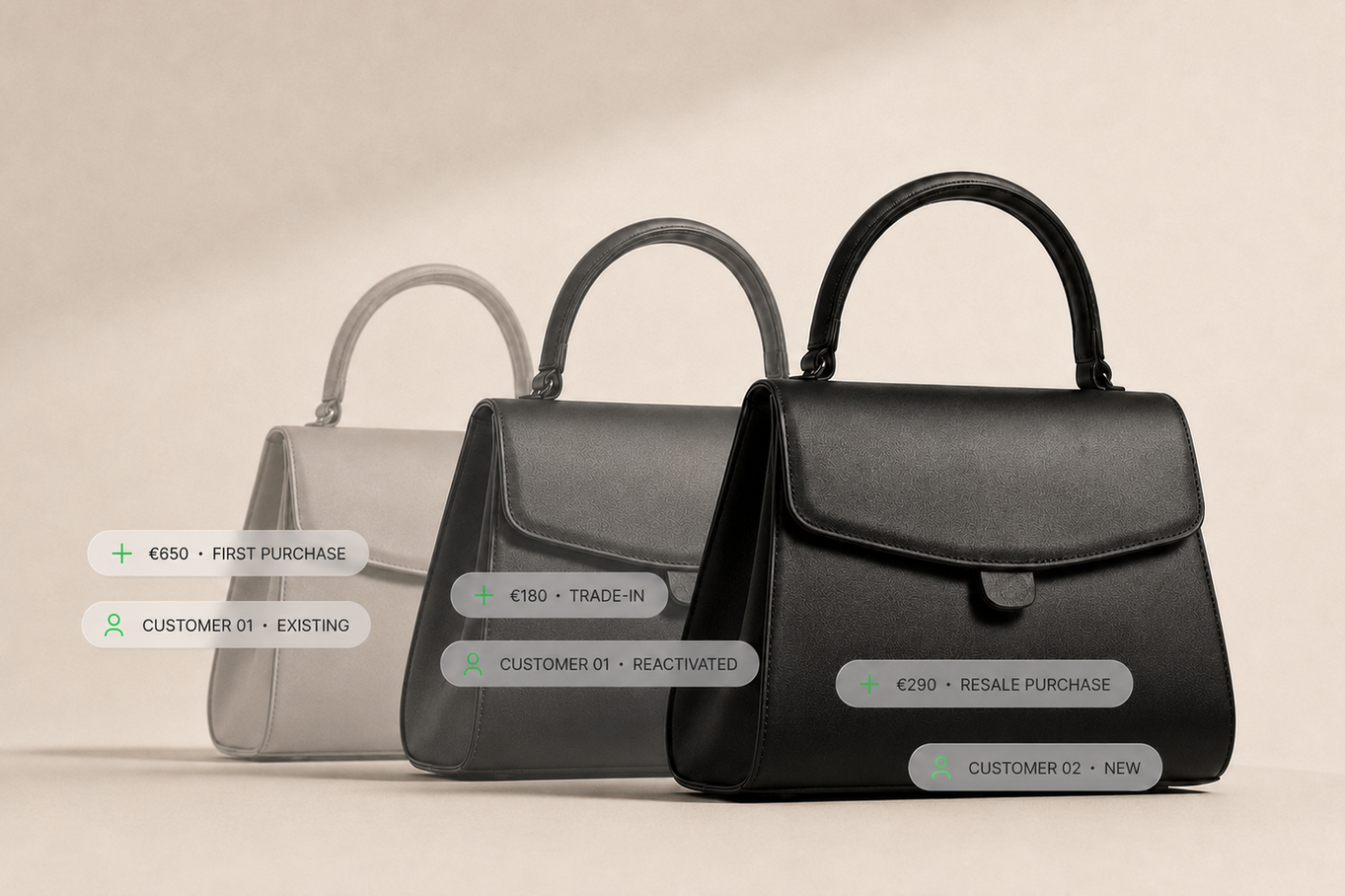
The most underestimated dimension plays out at brand entry. Secondhand is becoming, for a growing share of consumers, the first real commercial touchpoint.
McKinsey: 59% of consumers say they are likely to buy secondhand in 2026.
The Entry Journey Is Changing
Discovery happens on a platform. The first purchase happens off the brand's own site. Preference is built. Trust is formed. And none of it is captured in the CRM.
The brand captures the halo. The platforms capture the relationship: identity, purchase history, interaction data, intent signals.
Illustrative Case #2: Secondhand as Acquisition Channel
A premium sneaker brand launches a signature model at $280.
On the brand's website: 12,000 pairs sold in 6 months. New customer rate: 18%.
On Vinted / StockX / Vestiaire:
- 8,500 pairs resold in 6 months
- Median price: $180
- Buyer profiles: 72% new to the brand
The insight: Secondhand generated more new customers (6,120) than the official site (2,160). But the brand doesn't know them. No email. No purchase history. No ability to re-engage.
Takeaway: The customer relationship is built where the first purchase happens, not where the brand would prefer it to.
Price, Product, and Acquisition Are Part of the Same Loop
Secondhand is often discussed in silos: sometimes as a pricing issue, sometimes as a brand equity issue, sometimes as an acquisition issue. In practice, all three dimensions converge.
BCG / Vestiaire Collective:
- Secondhand already represents 28% of respondents' wardrobes
- Up to 40% for bags
- Price accessibility is cited as a primary driver by 8 out of 10 respondents
The Loop Effect
Strong resale reduces friction at entry. It makes a brand more accessible without cheapening it. It can accelerate trade-up behavior.
Weak resale produces the opposite. It fuels doubt about value retention. It reinforces the expectation of a markdown. It slows full-price sell-through.
In both cases, what plays out in the secondary market ultimately weighs on your new goods performance.
Illustrative Case #3: Value Retention as Reassurance
Two premium bag brands, both priced at $800.
Brand A:
- Median resale price after 2 years: $520 (65% retention)
- Average resale time: 8 days
- Active listings: 450
Brand B:
- Median resale price after 2 years: $280 (35% retention)
- Average resale time: 35 days
- Active listings: 1,200 (saturation)
Impact on new goods:
- Brand A: Full-price sell-through at 85%. A 5% price increase absorbed without friction.
- Brand B: Full-price sell-through at 62%. Growing promotional pressure. Price increase deferred.
Takeaway: Value retention in the secondary market is a pricing asset in the primary market.
The 2026 Priority: Building the Architecture
Faced with this reality, brands' instincts are understandable: tighten the offer, protect margin, better control distribution. Those instincts make sense.
The difficulty lies elsewhere, in the absence of a system connecting external signals to internal decisions.
The Issue Is No Longer "Doing Secondhand"
It is about connecting blocks that remain siloed:
- What is happening in resale markets: value retention, price dispersion, inventory velocity, categories rising or declining.
- What is being decided internally: pricing, product hierarchy, allocation, investment priorities.
- What is at stake at brand entry: capture, reassurance, reactivation.
What an Owned Program Delivers
An owned resale program does not provide full control over the secondary market. And that is not the right promise.
Dispersion will always exist. External platforms will continue to organize a portion of discovery and volume.
What an owned program does provide is a management lever:
- Setting a visible quality benchmark
- Establishing a price anchor on your own channel
- Standardizing the customer experience
- Recovering a portion of the new customer entry path
You do not eliminate dispersion. You reduce perceived dispersion. You do not control everything. You regain influence where it matters: value legibility, price anchoring, customer relationship.
The Indicators to Track in Review Meetings
A mature brand tracks, at minimum, by category and by product line:
- Value retention → Median resale price vs. new goods price
- Dispersion → Price spread across platforms and sellers
- Velocity → Resale time / inventory turn on key pieces
- Supply depth → Active listing volume on best-sellers
- External entry share → Share of new customers with a secondhand purchase history (where accessible)
- Impact on new goods → Full-price sell-through trends on lines exposed to secondhand competition
The value of this read is not just in the numbers. It lies in the quality of the commercial decisions it enables.
What a Mature Brand Does in 2026
A mature brand does not merely observe the secondhand market. It integrates it into commercial operations.
Concretely:
- Monthly review of external signals by category
- Explicit link to pricing decisions (increases, holds, range architecture)
- Explicit link to merchandising (lines to push, protect, or relaunch)
- Explicit link to CRM and acquisition (reassurance, trade-in, reactivation)
The key point is not another dashboard. It lies in decision discipline: who reviews what, at what cadence, and with what actual impact on commercial trade-offs.
It is structural rather than spectacular. That is precisely why it matters.
What "We're Watching It" Really Says
In 2026, saying "we're watching it" often amounts to catching up, after the fact, to what others have already built into their operating model.
Secondhand now occupies a different position. It measures, influences, and orients. It is already acting on your prices, your product portfolio, and your new customer pipeline.
The issue is not about achieving total control. It is about your capacity to reclaim influence over your products' value references, price anchoring, and customer relationships.
The real question fits in one line:
Are you letting the secondary market define the value of your products on its own, or are you taking back your share of that influence?
.png)



Stay ahead of the game!
Sign up to FAUME's The Secondhand Review newsletter
Read inspiring stories from brands that have successfully launched their secondhand businesses with FAUME